Tuesday, 11 March 2014

Cheltenham Festival 2014 - Day 1

As you may be aware, our offices are just a couple of miles up the road from Cheltenham Racecourse. This means that we all tend to pay particular attention to the Cheltenham Festival, if only to try and plan creative routes to and from work to avoid the race traffic!

Regular blog readers may remember that last year, our office bovine "CowCow" made daily race predictions by launching himself at a pile of printed horse names. You'll also recall that what he lacked in accuracy, he made up for in enthusiasm and facial hair. Nevertheless, he's back this year with a new prediction technique and a general aura of luck about him. Though that may, of course, just be his moustache shedding a bit. Either way, he's good to go!

How CowCow makes his race predictions
CowCow (complete with jaunty moustache), numbered spinners for each race, and the sophisticated spinner system which uses a winning combination of drawing pins, paperclips, cardboard and blue tack.


This year, we've created a numbered spinner for each race, featuring equal-sized segments representing the number of horses due to run. Each numbered segment corresponds to a different horse. To predict each race, the spinner is spun (with help from a human staff member) and then CowCow launches himself upon the spinner, stopping it in its tracks. Whichever numbered segment the spinner stops on becomes CowCow's prediction. Brilliant, we're sure you'll agree.


So, without further ado, here are today's predictions!

CowCow's Cheltenham Festival Predictions - 11th March 2014
Race 1 (1:30pm) - Vautour
Race 2 (2:05pm) - Grandouet
Race 3 (2:40pm) - Tour Des Champs
Race 4 (3:20pm) - Our Conor
Race 5 (4:00pm) - Pass The Time
Race 6 (4:40pm) - Rogue Angel
Race 7 (5:15pm) -  Ericht

Wednesday, 5 March 2014

PKL on The One Show

PKL Director Lee Vines and The One Show Presenter Matt BakerEagle-eyed viewers might have spotted my fleeting appearance on The One Show on Monday, talking about PKL KitchenPods as a potential solution for schools requiring new kitchen facilities to help with implementing the School Food Plan and Universal Infant Free School Meals.

The feature looked at the issues some schools will be facing in getting ready for the changes, and touched on several potential solutions. John Vincent from The School Food Plan helped a headteacher explore a number of options to ensure her school could meet the Plan's recommendations. The PKL KitchenPod at Bush Hill Park Primary School in Enfield was featured (thanks to headteacher Sue Crisp) as an example of modular kitchen buildings which provide flexible procurement options - including purchase, rental or lease - which can help schools without funding for an upfront purchase.

The feature also discussed options such as the local authority or private caterers borrowing money to invest in school kitchens, with the knowledge that a good facility will generate a profit, enabling the money to be paid back over time. Bringing the catering in-house was another suggestion put forward in the feature. This option can provide a great solution to schools whose current catering company may no longer represent the highest quality and most cost-effective solution when faced by the increased numbers of children who will be entitled to free school meals from September.

PKL KitchenPod on The One Show
One of our PKL Food Cubes was installed at the BBC studios for the day, for a live piece about how modular servery buildings can provide a solution to queues and congestion in school dining rooms. Mary Berry seemed to enjoy cooking pancakes in the Cube, describing it as "splendid" when interviewed by presenters Matt and Alex. Sadly we're not able to include a free Mary Berry with every Food Cube, but we do supply a variety of features and equipment,which we hope makes up for it!

I had a fantastic afternoon down at The One Show studios, watching rehearsals and pre-recordings. The studio is much smaller than I'd expected, but is run with such efficiency that a larger space really isn't necessary! I was also surprised to find that the outside filming area where our Food Cube was located is very open to the public, with people passing on the street able to watch from only a few metres away.


PKL Food Cube installation on The One ShowPKL Food Cube on The One ShowDuring a break in rehearsals, I had a chat with presenter Matt Baker, who was particularly interested in the issue as his own children don't currently have a hot meal option at school.

It was also nice to catch up with John Vincent from the School Food Plan and hear about the filming he'd done for the feature. I'm a member of the School Food Plan's Small Schools Taskforce, so we had plenty to talk about!

The show will be available to watch on BBC iPlayer until 10th March 2014, so watch it here asap if you missed it. The school meals feature starts 16 minutes in and lasts for about 10 minutes.

For more information on PKL school solutions, visit our dedicated schools website at www.schoolkitchens.com.


Friday, 31 January 2014

Temporary Prison Kitchen Features Explained

As PKL’s prison kitchen specialist, I appreciate the specific challenges involved in prison hires and have supplied a variety of temporary kitchen facilities to prisons, feeding from 300 to 1200 inmates per day. With a large number of prison kitchen hires undertaken during my time at PKL, I have helped to develop a number of kitchen features which are ideally suited to secure environments.

In this blog post I’ll outline a few of these key features available in our secure establishment kitchens, in order to tackle some of the questions I’m commonly asked about PKL’s prison facilities.

Safety and Security
Safety and security are important in any kitchen but even more so in a secure establishment.

The design of our kitchens can include both general and fire alarms, and cooking canopies are fitted with automatic fire suppression as standard.

The external doors to our facilities are prison specification and ready to receive prison category locks. Our kitchens can also have separate entrances for inmates and officers with hold and search areas if required.

Whenever possible, to maintain security during delivery, we use cranes either side of the prison wall to lift units over and then position them in place inside the grounds. This avoids a constant flow of vehicles through the gate lock and reduces security risks.

Visibility
Our open plan kitchen designs allow supervisory staff maximum visibility, and we use half height
walls where possible. Where this is not practical, we can fit polycarbonate vision panels instead.

To maintain line of sight, all our Central Island Canopies have through and through visibility, and the back-to-back design allows one officer to supervise multiple canopy runs.

PKL prison kitchensLayout
The wide central corridor in our kitchens allows for the easy flow of staff and goods, and this benefit extends into the main production and preparation areas thanks to the open plan construction. This makes best use of available space and provides the feel and flexibility of a permanent building.

The prime cooking equipment is located under Central Island Canopies which give the maximum extraction length without using large amounts of wall space and improve the layout and visibility.

Goods inward areas feature a reinforced floor to cope with the cage movement, plus over-door heating and a porch to protect the kitchen from bad weather while goods are being delivered.

Welfare
Open plan kitchens using Central Island Canopies feature thermostatically controlled tempered air which maintains the kitchen temperature – this is an essential feature for any open plan kitchen that is going to be onsite over the winter months.

Roof mounted plant rooms are placed above our Central Island Canopies and house the extraction fans and the boiler for the tempered air. The use of plant rooms ensures that there are no roof leaks where the extraction penetrates the ceiling, and significantly reduces noise both inside the kitchen and externally. It also improves security by preventing outdoor access via the canopy ducting.

Where the kitchen is going to be located near a housing block, optional sound attenuators can be fitted to the coldrooms to minimise night time noise.


I hope you’ve found this post useful in answering some of the questions you may have had about our prison kitchen facilities. Our kitchens of course offer a number of other features as standard, making them fully compliant with safety and hygiene regulations.

We can provide a wide variety of temporary kitchen facilities depending on your requirements, such as production kitchens, preparation kitchens, coldrooms and dishwashing facilities, so please get in touch for a chat if
you’d like to find out more about our prison kitchen options.

We also offer free, bespoke kitchen contingency plans to provide your prison with a tailored kitchen design which we could have on site within hours of a kitchen emergency.

Thursday, 30 January 2014

Preparing for Universal Infant Free School Meals

It’s now only a few months until schools will be required to offer free school meals to all pupils in Reception, Year 1 and Year 2.

While many schools have great enthusiasm for the changes, there are also a number of schools who feel daunted by the challenge and don’t know where to start! PKL have been active in the education sector for a number of years, supplying a whole range of catering infrastructure solutions, so here are my top tips to get you started.


Kitchen Facilities

This is one of the greatest causes of worry at some schools, but this need not be the case. There is government funding in place to assist schools with procuring kitchen facilities, and although the timeline may seem short, I can assure you that there is plenty of time to have everything in place by September!

The first thing to do is calculate how many meals your kitchen will need to produce each day. It’s worth bearing in mind that the pilot schemes found that school meal take-up also increased in other year groups following the introduction of free school meals for infants.

You should then make a list of all your current catering equipment and facilities (if you already have some) so you can ascertain what you’ll need in order to provide the meals required. Now’s also the time to consider new menu options and ideas, and plan accordingly.

It might be that you need to start from scratch with a new kitchen building and catering equipment, or you may just need to upgrade existing buildings or equipment. Either way, help is available in terms of both funding and advice. Visit our dedicated website, schoolkitchens.com to see our school solutions and relevant funding info. There is also an excellent “Q&A for Head Teachers” page on the School Food Plan website, which should help answer a lot of the questions you may have.

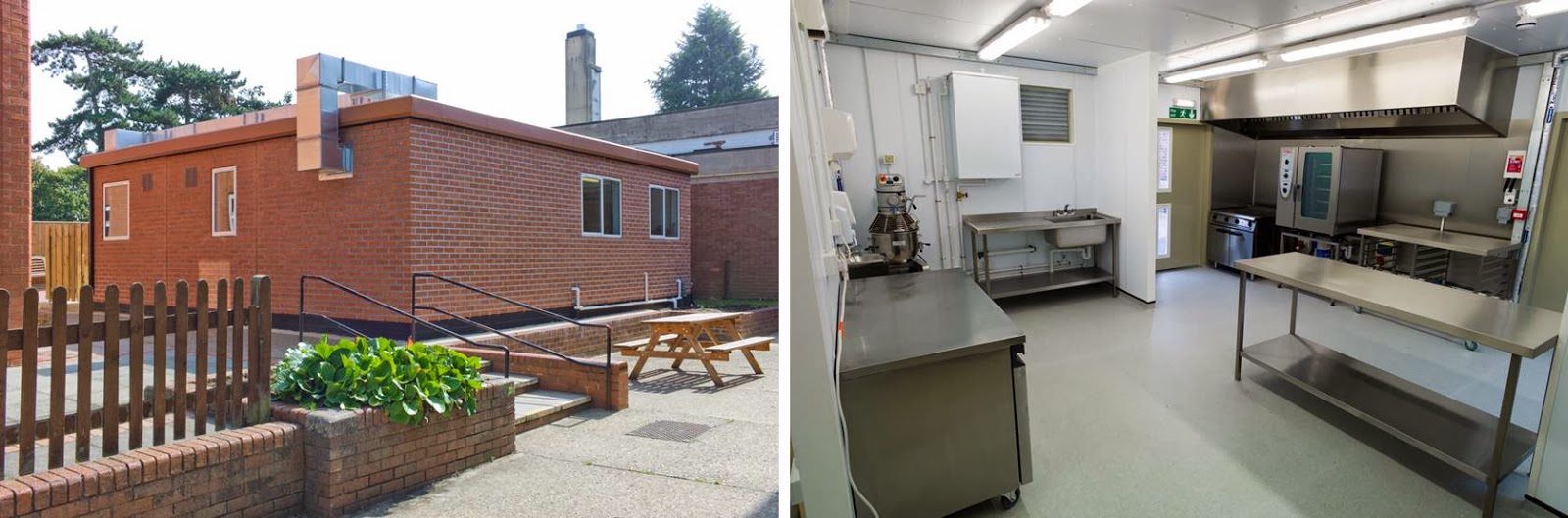
PKL Kitchen Options: If you need to install a new school kitchen or extend an existing one, take a look at our KitchenPod options, or if you need to procure or upgrade your catering equipment, take a look at our specially-designed KitchenFM for Schools option.

PKL KitchenPodsDining Space

As well as your kitchen facilities, you should also consider how your dining space will cope with an increased take-up of school meals. You might need to think about options such as staggered lunchtimes or additional sittings in order to help tackle queues and congestion in the dining hall.

Now is also the time to think about the practicalities of your dining space and how it can be optimised. You may be fortunate enough to have a dedicated dining hall, or you may use other spaces such as the school hall or classrooms. Whatever your current setup, there are likely to be ways in which you can tweak things to work better, be it new décor or layouts, an extension, additional dining areas or a whole new dining hall. The dining environment has been shown to have a real impact on pupils’ behaviour and engagement with school meals, so should not be overlooked.

Did You Know? PKL can also help with supplying dining areas as well as kitchens and catering equipment. Get in touch to see how we can help.

I appreciate that preparing for the implementation of free infant school meals may seem like an impossible challenge for some schools, but it needn’t be the nightmare you imagine. At PKL, we have a dedicated team who provide kitchen and catering equipment solutions to the education sector. They can help advise you on the best PKL products to suit your specific school, and offer a wealth of experience and expertise to help you through the procurement process. Take a look at schoolkitchens.com and please do get in touch if you’d like to explore your options further.

Lee has had over 19 years’ experience providing schools across the country with catering infrastructure solutions. He is passionate about school meals and was a driving force behind PKL becoming the founding corporate partner of the Children’s Food Trust. He is also a member of the Small Schools Taskforce, helping to provide solutions and support for small and rural schools in implementing the School Food Plan.

Tuesday, 14 January 2014

Quality: The importance of meeting quality standards

For the uninitiated, building a commercial kitchen often brings many problems related to local regulations as well as practical operational features that don’t quite work. Getting the kitchen infrastructure right first time allows the area to function properly straight away and to last under the demanding working conditions that a busy commercial kitchen faces.

In this post, I'll outline just a few of the design and quality considerations you'll need to make when procuring a commercial kitchen.

Regulatory Compliance


Wherever in the world your kitchen is being built, it must comply with local regulations. Not to do so can bring substantial, unexpected cost and delays to programme. Whilst regulations will vary from the European Union, to the United States, to Russia and the Middle East, there are common areas that they all cover. If you are aware of these areas, then you can ensure that your supply chain is paying the right level of attention to this detail.


  • Electrical Safety: Is the overall design of the kitchen, the individual components and the catering equipment certified to meet any international or local standards?
  • Gas Safety: Has the correct supply quantity been worked out? Are the pipes correctly sized? Are the component parts of the supply properly certified and installed by a competent engineer?
  • Food safety of construction materials: Are walls, floors and surfaces made of foodsafe materials?
  • Carbon dioxide and carbon monoxide testing: Around 20 people a year in the UK are killed by being in badly ventilated facilities, which can also cause illness. How will the kitchen be properly ventilated?
  • Montreal Protocol: Is the refrigeration and cooling plant compliant with this international protocol?
  • Lighting Levels: Is the space adequately lit to meet the local standards for a kitchen?
  • HACCP (Hazard Analysis and Critical Control Points): Does the design of the kitchen allow HACCP management, or is it fundamentally flawed from the outset?
  • CE Marked or GOST Certified: Is the catering equipment compliant with local standards?

Design and Build Quality

Regulations aside, kitchens are put under pressure by the use of water, the frequent use of cleaning chemicals, the heat of cooking processes and sometimes by unskilled or temporary users. Kitchens that are not designed and built to withstand these pressures simply do not last and will require replacement, or at least the cost and severe disruption of refurbishment, far sooner than the user might hope.

The build quality of the structure that the kitchen is housed in is also critical. Key features are adequate load-bearing for floors, correct wind or snow loads, heating and ventilation that are suited to local climatic conditions such as extremes of heat or cold, and dust. Like any specialist space, the internal design of a kitchen has many features that require close attention. These include fire safety, fire suppression, sufficient space between equipment, anti-slip floors, water resistant floor construction, services and sockets designed for easy cleaning and access, and infestation-proof construction of walls and doors to name but a few. Getting these things right makes a huge difference to the financial and operational success of a kitchen building project. 

PKL has 25 years of experience providing temporary and permanent infrastructure around the world. We sell and hire equipment, tented and modular kitchens that will meet local regulations and best practice in design and build quality. We get things right first time and aim to provide cost and programme certainty, giving peace of mind to clients who want to avoid unnecessary problems.

For more information on our international division, PKL Transworld, click here.
To find out more about UK kitchen hires, click here.

Monday, 23 December 2013

Christmas Opening Hours (and Christmas Jumpers)

A few staff members have taken part in PKL Christmas Jumper Day today, with Event Hire Executive Dan taking things to a whole new level with his elf outfit. A terrifiying sight, we're sure you'll agree!


We close today for the Christmas break, and reopen on Thursday 2nd January.

If you have an emergency over the Christmas period and require a temporary kitchen or items of catering equipment, our emergency response line is open 24 hours a day, and you can reach us on 0845 840 42 42.

For any non-emergency enquiries, please drop us an email and we'll get back to you when we reopen in the new year.

Wishing you a very happy Christmas and a successful New Year from all at PKL.


Monday, 2 December 2013

PKL Celebrates 25 Years with School Food Survey

As part of PKL’s 25th anniversary we are launching a ’25 on 25’ survey to find out more about school lunches from the past, present and future, and will be studying the potential impact this will have on schools who are currently investing in new equipment.

We’re asking people who were in primary school in 1989 to take our survey about school lunches from 1989 to find out how school meals have evolved over the past 25 years. So if you would like to be a part of this pioneering study you can take our short survey at: 


https://www.surveymonkey.com/s/8CY5P3V
 

As part of our survey we will be visiting groups of today’s primary school children to compare what they like and loathe about their school lunches. We’ll also be talking to leading school meals experts to gather opinions on the school food of today, 25 years ago and gain an understanding of what the school food environment might look like 25 years from now.

For schools who are working to implement the School Food Plan, we’ll be sharing insight into what pressure these changes in school food services will put on the school kitchen of 2039 and the implications involved.
 

We look forward to sharing our findings with you in the new year. Until then, you might find it useful to visit our SchoolKitchens.com website, or why not take a look at our 8 Point Plan for Schools that outlines a number of school food catering solutions for 2013 and beyond.